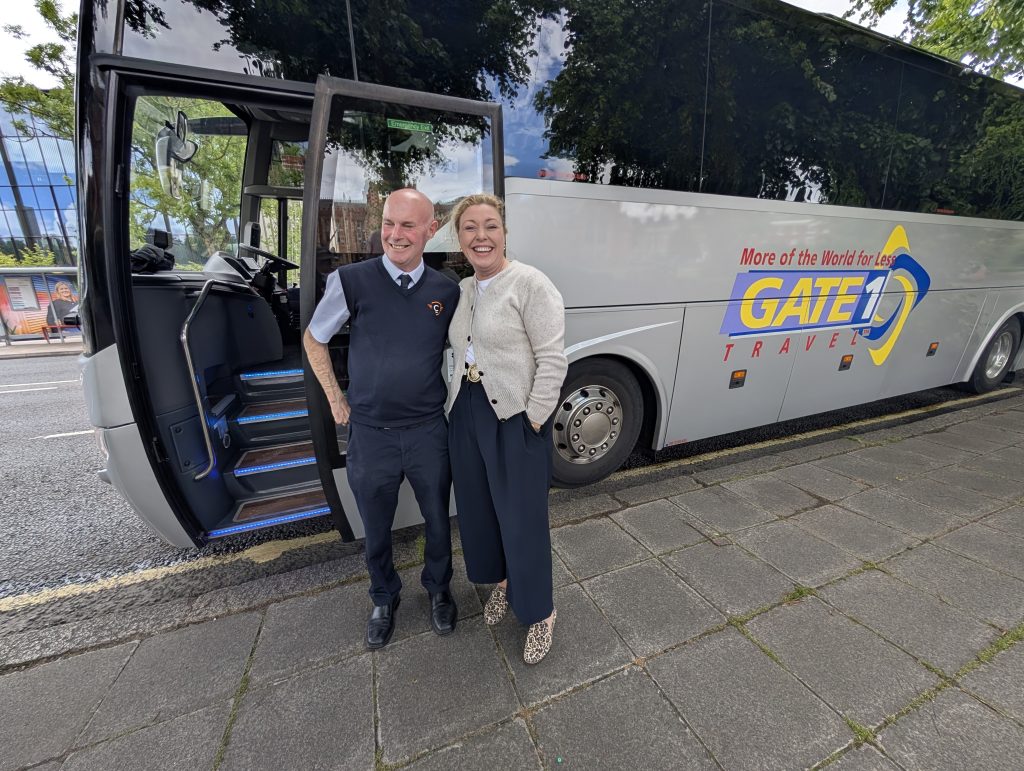
June 8 – Travel to Belfast
Our time in the Republic of Ireland comes to an end today as we drive to Derrytown in Northern Ireland. A local tour guide showed us around this city and gave us lots of background on the conflicts over the centuries in Northern Ireland. He is half Irish and half Chinese and a practicing Budhist with several teenagers. His hopes are that Catholic and Protestant children will be educated together and eventually break the barriers held up for generations.
The island of Ireland is split into two jurisdictions: Northern Ireland and the Republic of Ireland. Northern Ireland is part of the United Kingdom while the Republic of Ireland is an independent, sovereign nation. There is no physical border between the two, but there are many differences between Ireland and Northern Ireland. Most of our trip has been spent in the Republic of Ireland which is part of the EU and uses euro for currency. Northern Ireland is part of the UK and uses pounds sterling. There are six counties in the North and 26 in the South.
Essentially, after being ruled (officially) for over a century from London by the British, Ireland achieved independence from the United Kingdom in 1922. Because of religious, cultural and trading links to the rest of the UK, Northern Ireland almost immediately rejoined the United Kingdom. https://www.theirishroadtrip.com/northern-ireland-vs-ireland/. The capital of Republic is Dublin and Belfast is the capitol of Northern Ireland.
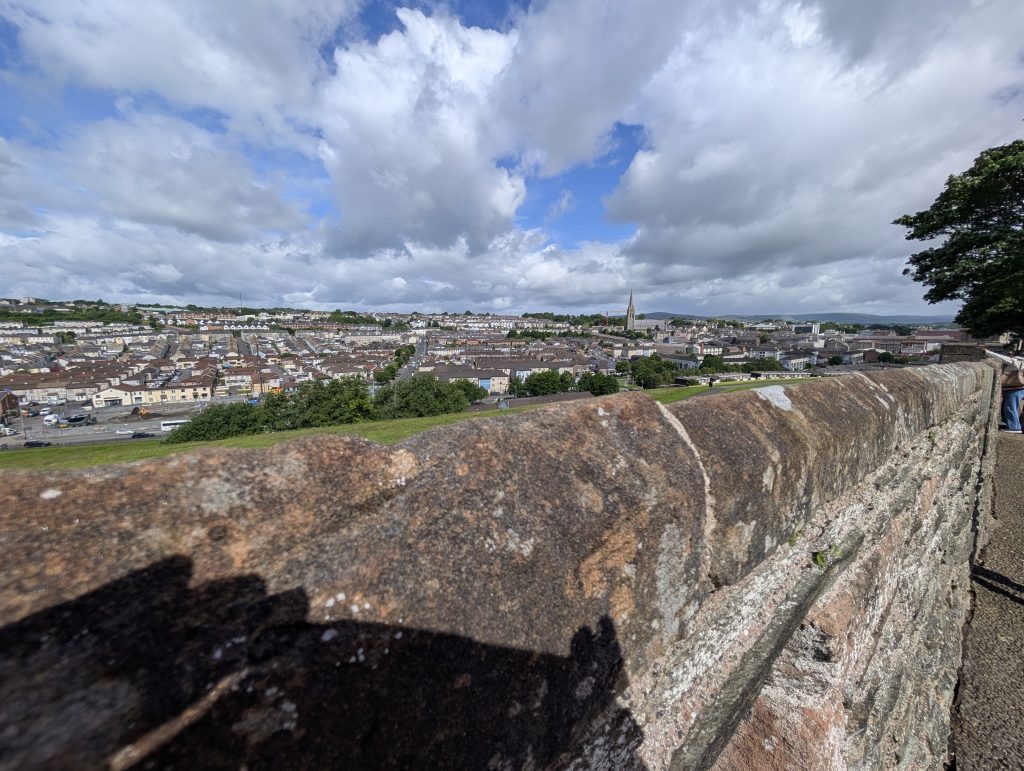
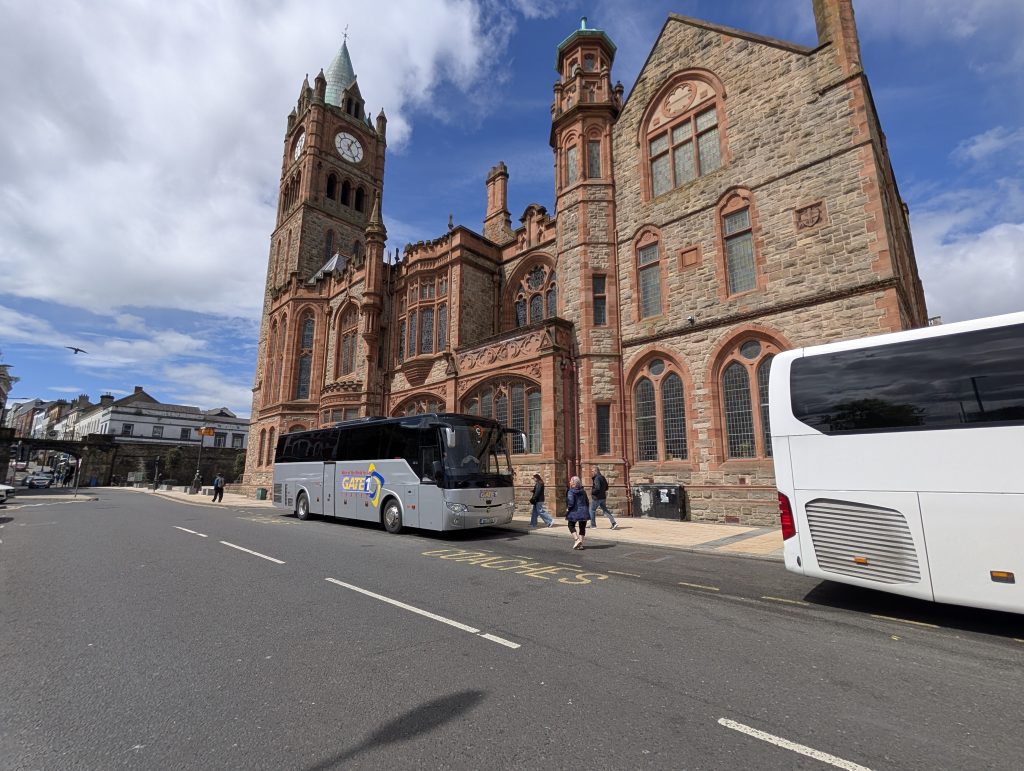
We spent some time inside and outside the massive City Hall in Derry which looks more like a church than a government building. We had trouble finding lunch in Derry before our departure for Giant’s Causeway. Most restaurants in Ireland do not open for lunch before noon.
The stop at Giant’s Causeway was the highlight of the day. The Giant’s Causeway is on the north coast of Northern Ireland in County Antrim. It is comprised of approximately 40,000 interlocking basalt columns and stones, the result of an ancient volcanic fissure eruption, some 40 million years ago. Most of the columns are hexagonal and some are as tall as 40 feet. It is the first UNESCO site in Northern Ireland and only one of three in the UK designated for natural heritage.
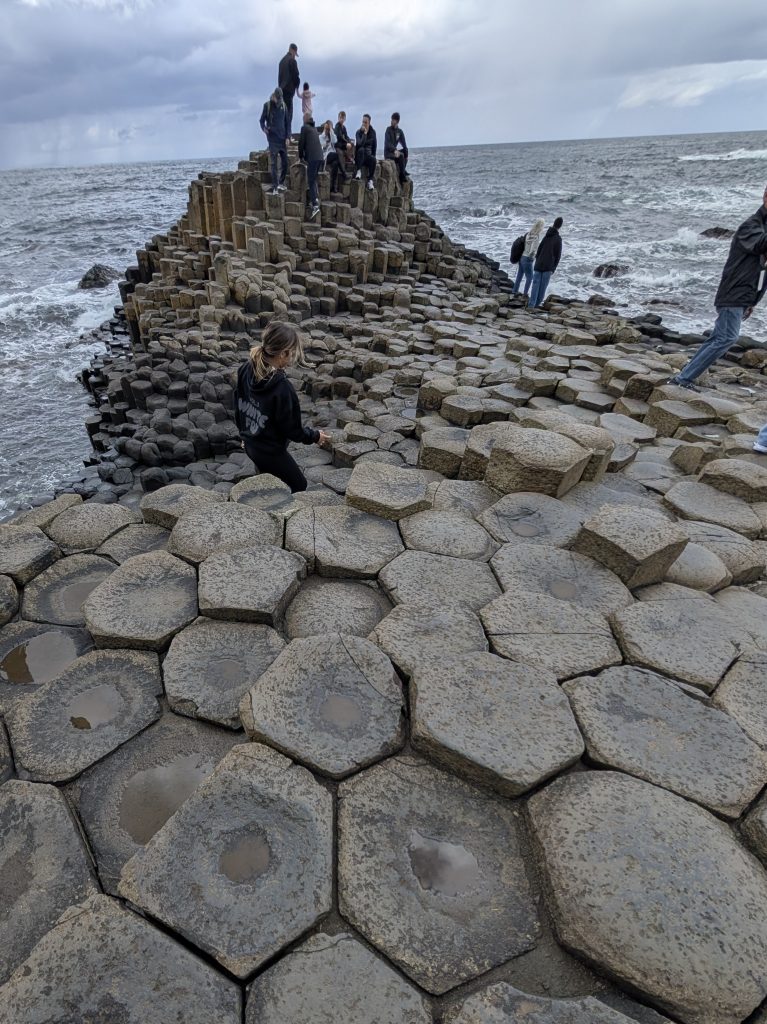
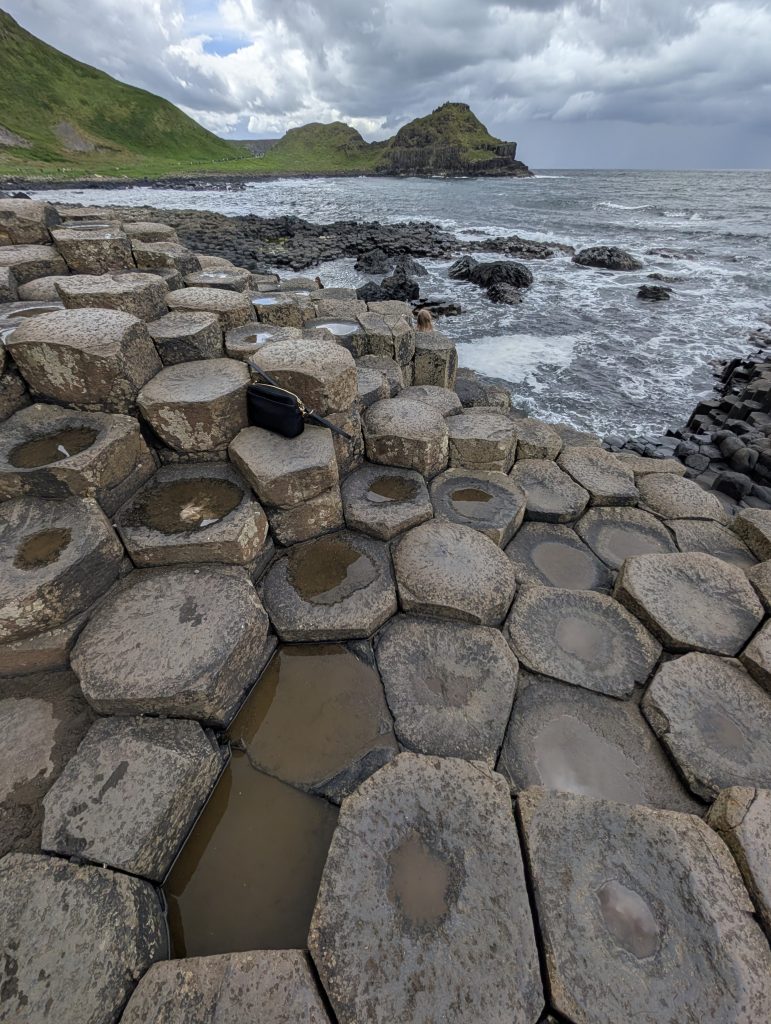
According to legend, the columns are the remains of a causeway built by a giant. The Irish giant Finn MacCool was challenged to a fight by the Scottish giant Benandonner. Fionn accepted the challenge and built the causeway across the North Channel so that the two could meet. In one version of the story, Fionn hides from Benandonner when he realises that his foe is much bigger than he is. Fionn’s wife, Sadhbh, disguises Fionn as a baby and tucks him in a cradle. When Benandonner sees the size of the “baby”, he imagines that its father, Fionn, must be a giant among giants. He flees back to Scotland in fright, destroying the causeway behind him so that Fionn would be unable to chase him down. Across the sea, there are identical basalt columns (a part of the same ancient lava flow) at Fingal’s Cave on the Scottish isle of Staffa, and it is possible that the story was influenced by this. (https://en.wikipedia.org/wiki/Giant’s_Causeway)
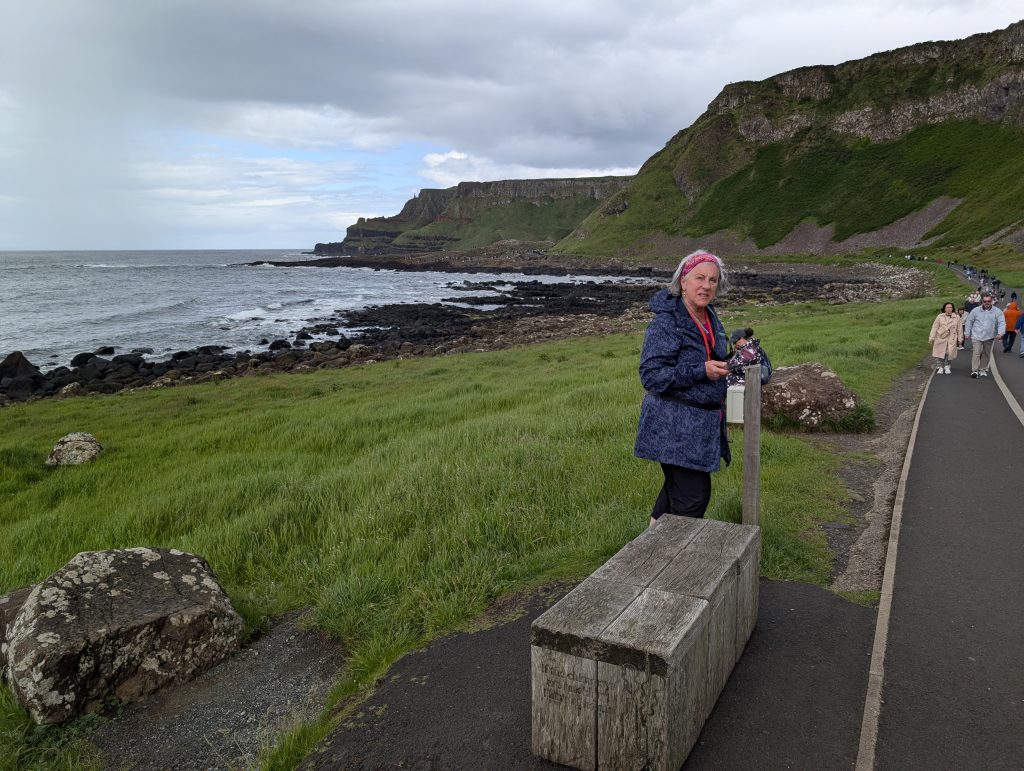
We had enough time to take a hike along the water’s edge to climb the stones and listen to an audio-guide describing key spots. We would have liked to stay longer and continue the hike up but we still had more driving to do to reach Belfast before dinner. For 1 pound you can ride a bus back to the visitors center but the lines were very long and very slow so we fast walked it back up the hill before the rain started. We heard they stopped the busses to make way for an ambulance because someone was jumping on the columns and apparently missed and fell. Ouch!
June 9 – Belfast
The Europa hotel in Belfast was very elegant and centrally located. The rooms were nice and it was close to the train/bus station.
We had a tour of Belfast with a local guide on the bus who pointed out key sites and tried to explain “The Troubles”. We drove through Catholic and Protestant neighborhoods – noting their different street murals and flags. The two neighborhoods are separated by a graffiti covered “Peace Wall”. These walls separate the Irish republican/nationalist Catholic neighbourhoods from the British loyalist/unionist Protestant neighbourhoods. You would think it was time for these barrier walls to come down. Both neighborhoods showcased street art – the catholic side had lots of pro-palestinian messages while the protestant side had lots of British icons on their buildings.
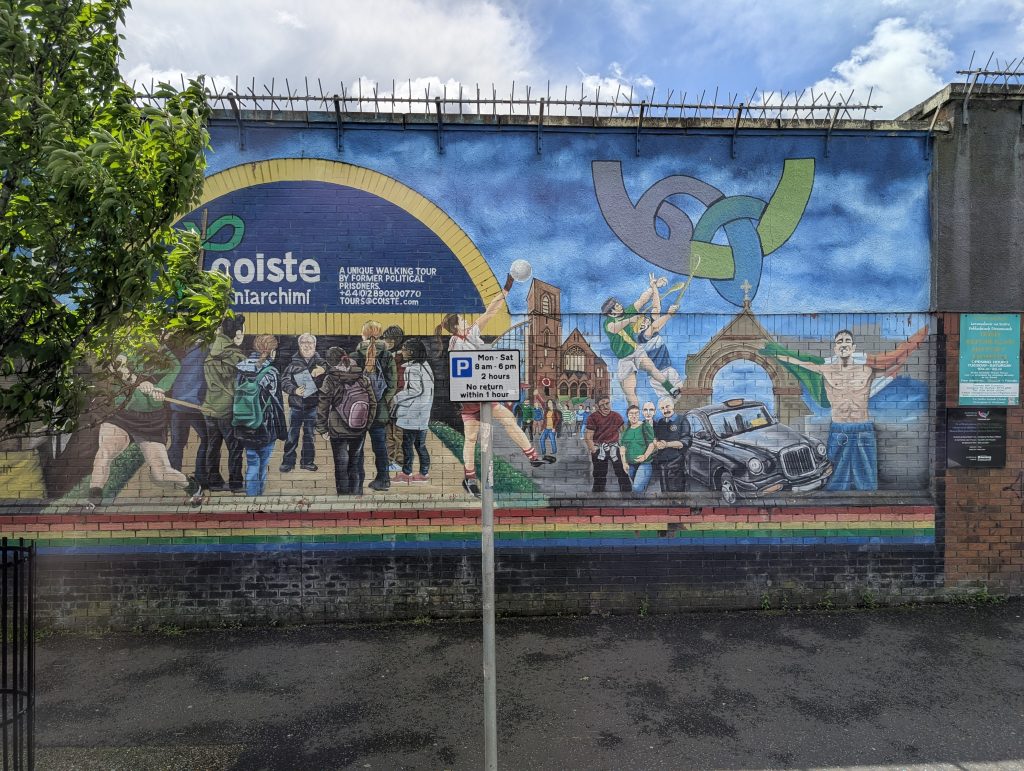
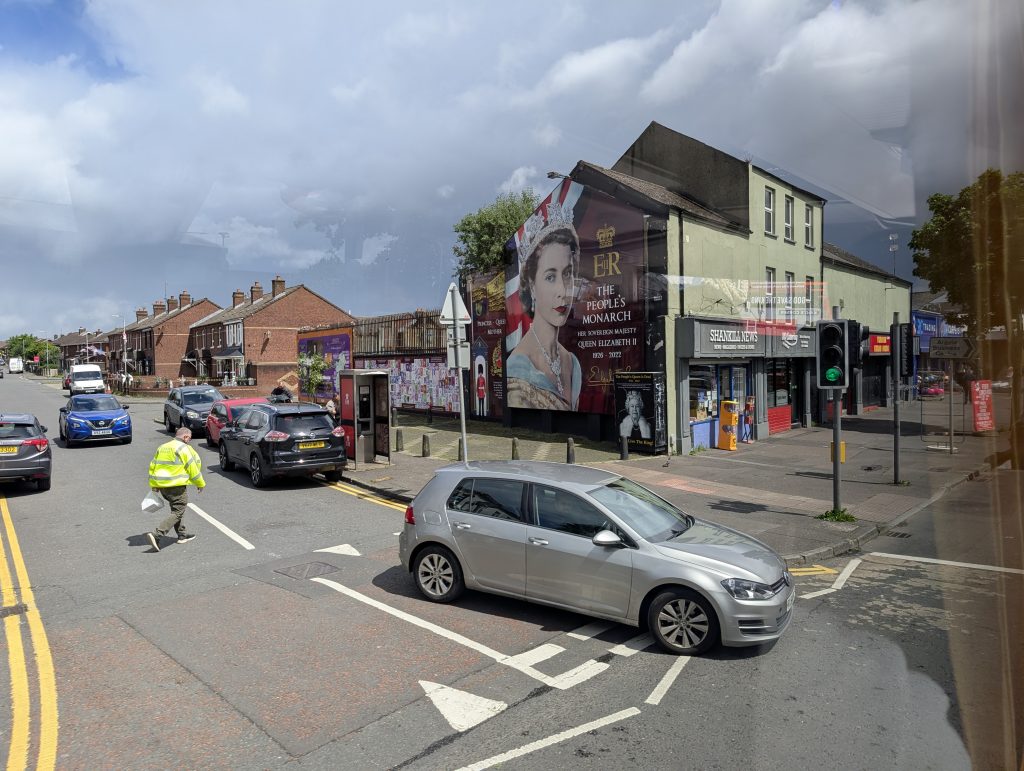
The Troubles was a violent sectarian conflict from about 1968 to 1998 in Northern Ireland between the overwhelmingly Protestant unionists (loyalists), who desired the province to remain part of the United Kingdom, and the overwhelmingly Roman Catholic nationalists (republicans), who wanted Northern Ireland to become part of the republic of Ireland. Some 3,600 people were killed and more than 30,000 more were wounded before a peaceful solution, which involved the governments of both the United Kingdom and Ireland, was effectively reached in 1998, leading to a power-sharing arrangement in the Northern Ireland Assembly at Stormont. There is still talk about Northern Ireland uniting with the Republic of Ireland but one 60 year old man we met in a Belfast pub said it won’t happen until my generation is gone because people have long memories. (https://www.britannica.com/event/The-Troubles-Northern-Ireland-history)
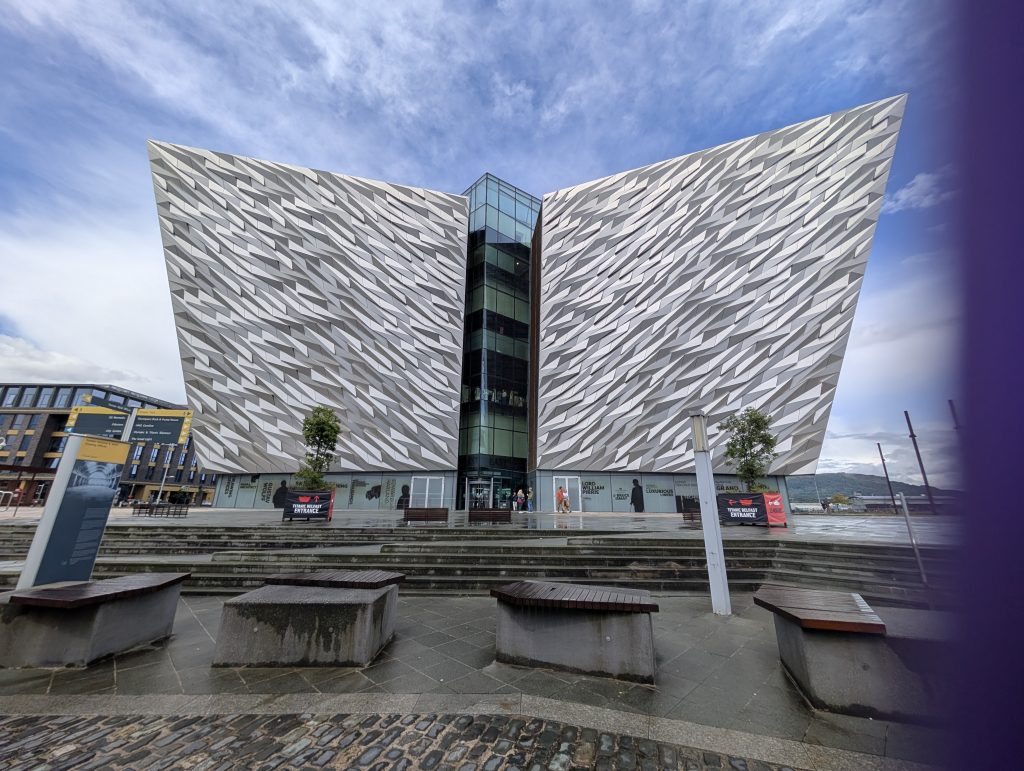
After our bus tour we went to the Titanic Belfast experience which was excellent. It is an immersive modern exhibit. Located beside the very place where Titanic was designed, built and launched, Titanic Belfast tells the story of Titanic from her conception, through her construction and launch, to her maiden voyage and subsequent place in history. The building’s exterior is quite iconic – its design is intended to comprise several maritime metaphors including water crystals, ships bows & the White Star logo. The museum was opened in 2012 for the 100th anniversary of the ship’s maiden voyage and sinking. When we were in Halifax last summer we visited the Maritime Museum of the Atlantic who has a Titanic exhibit that tells the story of Titanic’s creation and demise, drawing out the key role Halifax played in the disaster. We also visited the Fairview Lawn Cemetery in Halifax, which contains the graves of 121 victims of the Titanic disaster.
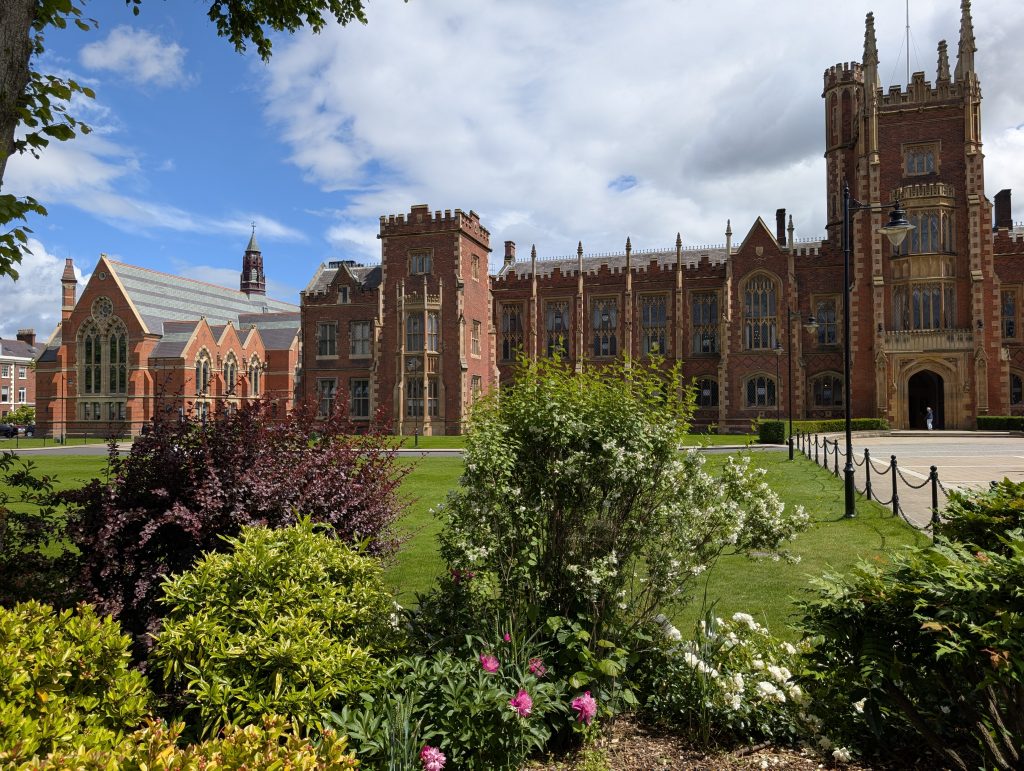
During our free afternoon we saw Queens University and visited the Ulster Museum which has collections of art, natural science and history. Definitely worth at least an hour with an exhibit on “The Troubles” as well as art galleries and a fashion exhibit.
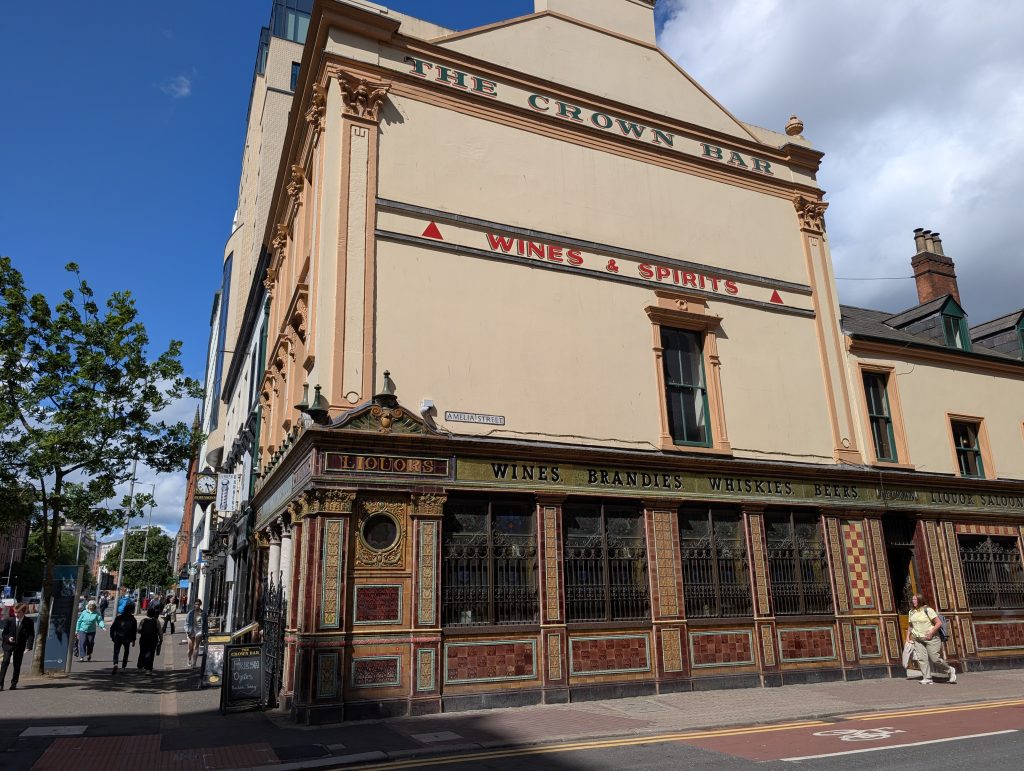
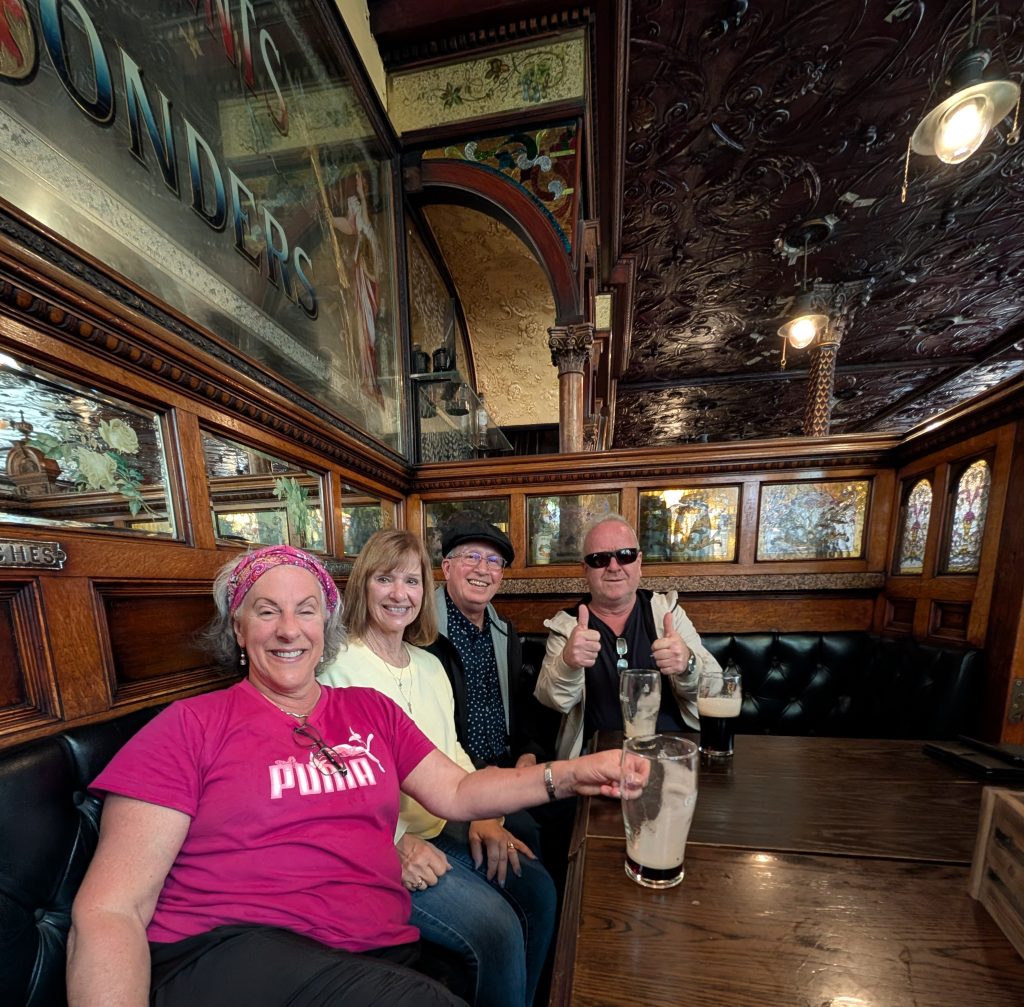
We headed back to our hotel and popped into the famous Crown Saloon across the street from our hotel. This pub was built in 1826 and has remained open for 200 years. The pub has beautiful tiles on the exterior while the interior boasts elaborate tiling, beautiful stained glass and woodwork installed by an Italian craftsman. The Crown has ten cosy snugs, private booths built to accommodate some of the pub’s more reserved locals during the Victorian period. The snugs still feature the original gun metal plates for striking matches and an old antique alarm bell system for alerting staff. Modern updates include a bar code for placing drink and food orders. We were able to find an empty snug to visit with some people from our tour. We particulary enjoyed visiting with a Dubliner who was in Belfast for the day to have a few drinks. Seniors get free train travel in Ireland and he was in Belfast for the day. He talked to us about growing up in war torn Ireland in 70s and 80s. We have found that the Irish are very friendly people and always up for a conversation.
Last night there was a terrible attempted murder not far from our hotel where a Sudanese immigrant tried to decapitate a local who had offered him help. The only reason the victim survived was because there bystanders stepped in, one with hurling stick. People in the UK are getting very angry about illegal immigration and the crime by immigrants on the locals. Big protests are planned tonight in Belfast and most businesses closed by 5pm. We decided it was best to stay in the hotel after our farewell dinner.
On the 10th our Gate1 tour came to an end. It was a great way to see Ireland and learn about its history and experience its culture.